Thursday, January 24, 2013

The Inauguration of a President – What You Don’t See on TV

-->


By now you’ve seen many images of the second inauguration of President Barack Obama in many forms. Television, videos, photographs, magazine and newspaper accounts all neatly packaged and nicely presented. Ready for primetime. The promotion of democracy at it’s very best.

What you don’t see is the journey of the people whose flag waving images fill the National Mall and presidential parade route. Over one million individuals traveled to the nation’s capital for an outdoor event in January that lasted just about six hours.

What you don’t see are those people walking for miles along with hundreds of thousands of others to witness history. There is no other way to get to the Mall other than walk. Many of those taking that journey, were in wheelchairs being pushed along by friends or family members, some hobbling along on crutches and canes, some whose breathing is aided by oxygen tanks.

What you don’t see is the hospitality of the people of the Washington D.C. who host the festivities every four years. Shop owners who allow people come in to use restrooms, to get out of the cold and/or to sit for a minute. Scores of volunteers who are up as early as 5:00 in the morning in frigid weather acting as cheerleaders congratulating the people as they (finally) reach the Mall.  The hundreds of vendors from all over the country selling their souvenirs. The museums that remained open so people can stop by and take a tour.

What you don’t see is the heavy security. The snipers atop buildings, the police and their dogs, the military presence. All there to make sure there are no problems. So much order amid so many people is amazing. There has never been an incident.

What you don’t see is the effect of the realization that the on the very same ground you are walking upon stood soldiers fighting the Revolutionary and Civil Wars. It is where Martin Luther King gave his “I Have a Dream” speech. One can overhear parents telling the stories to the youngsters.

People came to Washington D.C. from all over the world to be a part of the historic event. Old, young, black, white, brown and tan. The people who did not wait for a formal invitation because they knew none was needed.

What you did not see was everyday people doing an extraordinary thing.  Why, because we know we may never see this day again so we went to Washington (and took the kids) to be able to tell the story to future generations.


Wednesday, December 19, 2012

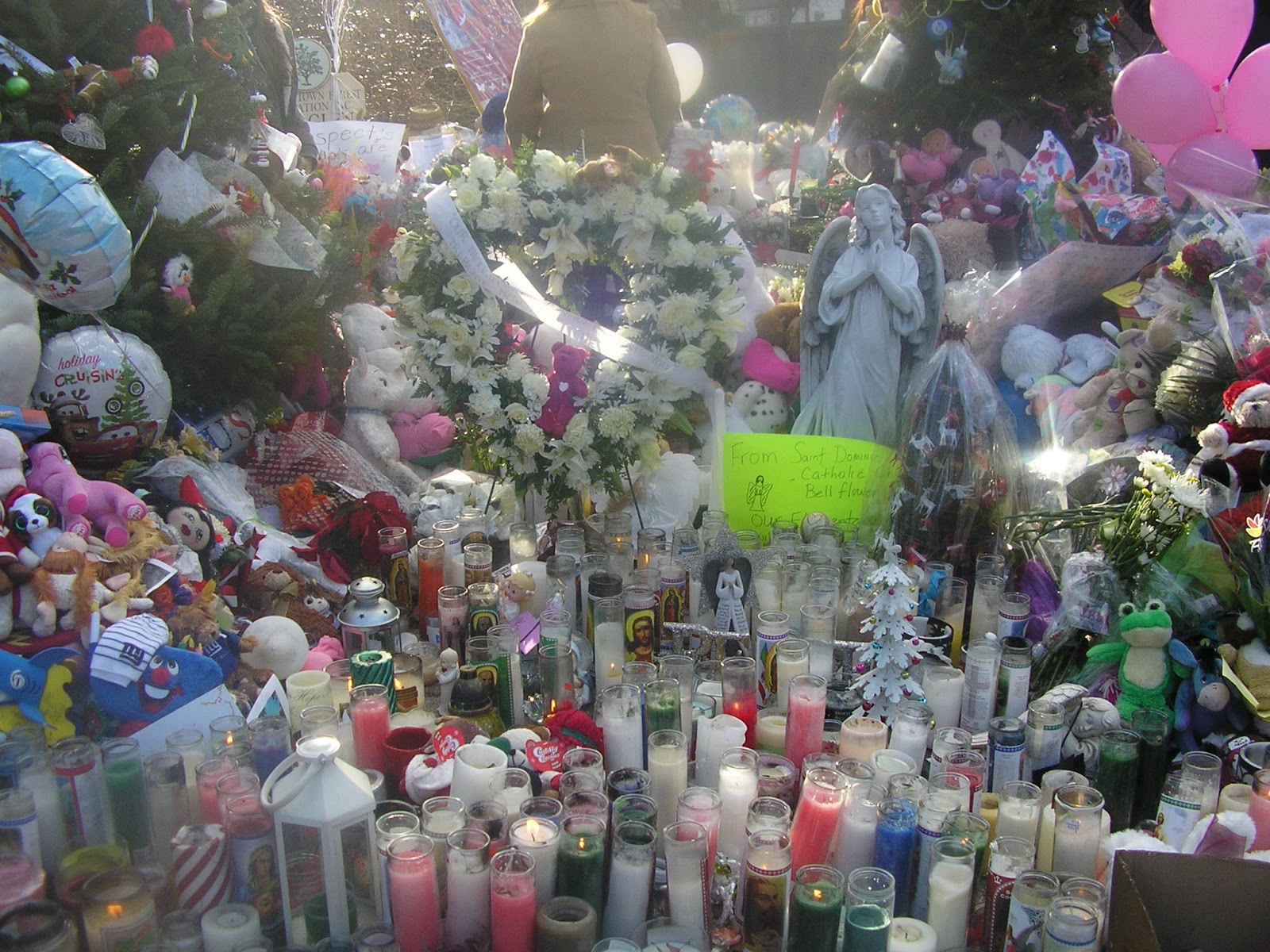
A visit to Newtown, CT

--> TV does not do the devastation felt in Newtown, CT justice. Seeing thousands of people, cars, flowers, police, media, memorials and passing hearses up close and in person was like a punch in the gut. So overwhelmingly sad and tragic. 

Quite frankly it made me sick to my stomach!

 Mass Memorial Site 

Sunday, December 16, 2012

Incident at Sandy Hook Elem. School in Newtown, CT – A “Mentally Ill” Man Speaks Out

This was written by my friend William C. Jackson. I will add no words to the discussion as the piece speaks for itself. 

Originally posted on Facebook December 14, 2012

"Rant/Commentary...I am just going to come out and say it...I am mentally ill. I am not joking here. It is the truth. I have been battling depression and anxiety for the past five-and-a-half years. And for all the problems I have had, including dealing with cruel, insensitive people, I have never thought about buying a gun, and then going to a public space to start opening fire (My illness is well-documented, so I wouldn't be able to get a gun, anyway).

I said that if it is revealed that the scum that killed all those people at Sandy Hook Elementary School in Newtown had a mental illness, I would be EXTREMELY angry. Why? Because I have a mental illness. And most people with mental illness are NOT violent. They want to be treated just like everyone else, and I am no different. But with things such as this happening, there is a stigma associated with having this illness (Can he be trusted not to hurt anyone if something bad happens to him? for example).

William C. Jackson

I feel for the families of the families of the victims, especially those that will be without their child for the holidays.

I believe that there is a special place in hell for people like the gunman.

Please, media, do not say that he had a mental illness. Don't make it harder for people like me.


Monday, November 12, 2012

SALUTE TO FEMALE VETERANS


 I am a United States Army Veteran. Decorated. From the old school discipline of “Be All You Can Be.”

Indoctrinated by the Government to kick ass and take no names. 
I – fear – no – evil. 

That’s Girl Power Baby! 

WhooRaahh

Monday, September 10, 2012

9/11 Revisited

Edited excerpts from various articles I’ve written on my experience at Ground Zero.

To this day I cannot explain what made me go to New York. It’s just that despite the images I saw over and over on the television screen I still could not believe it. Really. I had to see for myself.

September 13, 2001 - I just came back from the other side  “Ground Zero” they ‘re calling it. The scenes there are unforgettable, unimaginable, and incomprehensible. I will never forget the sight of fire and smoke rising from the hole in the sky where the World Trade Center once stood.

The streets were littered inches thick with dirt, dust, soot, glass, metal, ashes and burned paper everywhere. I’m aware that mixed in the debris are body parts. The twisted wreckage of cars, trucks and vans all cemented, seared into the streets, on the sidewalks and against the sides of buildings. The fire trucks, police cars and emergency vehicles stood frozen in time completely mangled and upsided. I was totally unprepared to view the devastation. People on the street openly weeping, it was too much to process.

Lost/missing pictures of loved ones on bus stops, trees, the sides of passing trucks and store front windows. The yellow ribbons, the candles, the makeshift shrines. Red, white and blue on everything worn by everyone. The sight of the men, and women buses and trucks as they enter and exit the  scene of the crime. The faces of these heroes exhausted and drained. Being in a crowd of 10,000+ people who are silent or whispering or weeping, all staring in disbelief.       

  
Ground Zero Remains         


Hundreds of cars, trucks, vans and military vehicles filled with volunteers from all over the country also included (surprisingly) “inmate work crews.”


The events of September 11, 2001 gave us a new sense of our place in the world. Goliath fell that day, it’s still a hard pill for us to swallow.

Yet tonight as I sit here at my computer looking over at what can best be described as my memorial from that day, a foot high glass bottle filled with ashes burned financial papers, twisted blinds taken from the crime scene I’m sure of one thing. The events of 9/11 are the direct result of hatred. Hate can have no place in our lives. 


Wednesday, June 6, 2012

Interview with a Literary Agent


GINA PANETTIERI - TALCOTT NOTCH LITERARY
by Jocelyne Hudson-Brown

The purpose of this paper is twofold. It satisfies a class assignment to interview a leader in the communications industry and it is also my hope that it provides another MACOMM student with an interest in the literary field some insight into the profession. It seemed fitting that I do this in print form in opposition to a produced video piece because the “printed word” putting print to paper, is the truest from of the literary art form.
Part 1 of the following interview with Gina Panettieri was conducted on May 25, 2012 at the office of Talcott Notch Literary in Milford, CT.  Part 2 was conducted at 2012 BookExpo America at the Jacob Javits Convention in New York on June 5th 2012. 

Part 1
I met Gina Panettieri while satisfying a 200 hour internship as part of the MACOMM curriculum. I found her to be warm, available and just a wealth of information. The following excerpts are from an interview where she freely answered 
questions.

Gina Panettieri

Jocelyne Hudson-Brown - How did you get your start in the business?

Gina Panettieri – My start was not traditional. I was hosting a writers support group; soon writers began asking for help. I began advocating for writers, interviewing attorneys, editors, writing letters, just doing it to be supportive. People began saying “You are good.” I got no pay just satisfaction. Then someone suggested that I do this for profit. So in 1988 I said, “You’re right” and I have been going ever since. You must understand when I first started there were really no internships. People got a job and stayed for 20 years. Interns have the opportunity to learn a profession and practice it.

JHB - In these lean times (for your industry) how are you surviving?

GP – Good Question. There have been a number of failures. Borders, small bookstores…they failed to make the transition. This (economy/digital advances) has challenged everyone. The big change right now is the Amazon dominance. They are both a selling platform and a publishing platform now, stealing some of the biggest authors. They (Amazon) have unlimited resources. Publishers now have the double challenge of the economy and Amazon. Some agencies are now offering more. They are serving as publishers also publishing to “E” format, doing editing, providing cover art. Providing more services.

JHB - What adjustments have you made to adapt your work to the “ digital” way of doing things?

GP - There is money to be made in digital. Using their (Amazon’s) experience and knowledge. Joining them makes sense for agencies. An eBook now comes automatically with print.

JHB – Correct me if I’m wrong. I think no matter the advances occurring with digital publishing, people still want a real book.

GP - God yes! They still want to hold it in their hands. I know of one author who has had 5 books published. The first 4 were digital, the last one in print. She said the print one was the first one that felt “real”. There is something about getting that box of books, of seeing it on the shelf. Also, monetary commissions are greater when a book is taken to print. When a book gets printed it is a commitment to the author from the publisher. They (the author) get more support, a real push with regard to marketing and promoting.

JHB - What do you see for the future of your industry?

GP - Books will survive. Hardcover sales are up. People like books for collecting, and then there are the coffee table books. Books are beautiful. Also, some books do not translate well to digital. Picture/Art books, recipe books. Seeing them on Kindle does not have the same effect.

JHB - What might be considered the downside (negative) of your profession?

GP – Commission based income can be a downside. You have to sell (books). Any work based on sales can be scary. But, if your book just had a big hit you will be glad not to be on salary. It is not a 9-5 job; you will be reading on evenings and weekends. About 50-60 hours a week of reading. Clients will want your time. The hours can be demanding. Then there is travel for conferences. Most publishing events are held on weekends. If you are a person in demand the weekend is taken up with conferences, clients, making contacts. It is a commitment not a Monday-Friday, 9-5. You have to love books, talking about books, meeting people. It’s an art, it’s terrific.

JHB - Besides the usual “follow your dreams” is there any advise you could give?
You need to know your market, study it. Subscribing to industry magazines and journals enables you to make informed decisions. Within them is a ton a free content. Educate yourself. This is also a profession that requires “personality”.  It is definitely not for the risk adverse. You cannot be frightened by challenges and you must have drive and ambition. Know your genre and understand the rules. Study what successful people in you market have done. 


Part 2 BookExpo America, Jacob Javits Convention Center New York, NY

 BEA Publishers Exhibit

BookExpo America (BEA) is an annual industry event that features over 1350 exhibitors from all over the world. They include literary agents, publishers, book dealers, digital suppliers dealers. Most every major player in the industry is represented. Literary professionals from all over the world are featured. Included were representatives from Russia, Japan, Saudi Arabia, and Germany among others.
Individual elements include bloggers conferences, educational seminars, author interviews, photo ops and autograph sessions and galley giveaways.
 
The professionals that attend the event are book publishers, literary agents, teachers, book buyers for schools and universities, book sellers (store owners), librarians, anyone who may be responsible for recommending books to be acquired or purchased. It is not open to the general public.

Product categories exhibited are adult trade, art/photography/coffee table, body/mind/spirit, business books, children/young adult trade, cookbooks, drama, education/how to, environmental/natural world, erotic, foreign language, gay/lesbian, graphic novels, health medical, history, humor, large print, literature/poetry, multi-cultural, philosophy, professional educational, reference, religious, remainders/bargain books, science fiction/fantasy, scientific/technical/professional, self help/recovery, Spanish books, text books, travel outdoor recreation, university press, women’s studies/feminist, coloring books, journals, hobbies and crafts, bookmarks/bookplates, calendars, limited edition, and stationary.

Representing the digital domain are exhibits that featured the latest apps, devices/e-readers/tablets, digital marketing, digital services, eBook accessories/ eBooks, e-publishing solutions, mobile products and services, search engines, social media, software development, internet marketing and sales.

Support services featured included publicity/promotion, distribution, posters, inventory control, rights/permissions, retailer supplies/services, music and audio video.

The primary reason for highlighting so many components of BEA in this writing is that each one represents a specialty/niche within the literary profession. Seeing them all in one place at the same time was quite exciting. A book (any book from any genre) is a lot more that words on a page with a nice cover. Anyone with traditional experience in communications (audio/video, writing, production, internet/web specialists) will find their skills are easily transferable to the literary field where they are very much wanted, needed and appreciated. What is great about it is that one can easily find themselves as the biggest fish in a small pond particularly where production and digital expertise is concerned.


While at BEA the interview with Gina Panettieri continues:

JHB - How long have you been coming to BEA?

GP - This must be I think my tenth year.

JHB – This is my first time here. So much to see and do, I am very excited and a bit overwhelmed and over stimulated in a good way. (I consistently overheard this from other attendees as well.) As a literary agent with your experience what does the BEA mean to you? For me it is a total exposure to the industry. What does it do for the more experienced literary agent?

 Gina meets w/author at BEA

GP – It gives me an opportunity to see what publishers are excited about, what they are promoting, their big titles. It gives me a chance to speak with other publishing professionals and to interact with them. If I have a product that is appropriate I can take a one-on-one appointment with them and pitch certain projects.

It just gives me more of an opportunity to get an idea of what’s going on in publishing. There are workshops, panels and seminars that are going on that are very informative. It is both a selling venue and an educational forum. People can use it for a number of different purposes.

JHB – Thank you Gina for a wonderful opportunity. I appreciate seeing the literary arena like this. Indeed, one can never judge a book by its cover!


Saturday, January 14, 2012

ETHICS - Secrets Revealed?


From the point of view of a journalist the discussion begins with “information that becomes known to you and you could release to the public.” Would you reveal it? 

First of all, I would be anxious about even having such a secret (there are always repercussions). If said secret is an important part of the story not just a salacious entry I feel it should be revealed. Of course, there will be people (stakeholders) who do not agree.

As indicated in my first post “Watergate” comes to mind most immediately when it come to the media, journalists and the revelation of secrets.  What began as a story about a burglary ended with the toppling of a president.  The “secrets” involved former FBI agents, White House staff and President Nixon all involved in illicit, illegal activities, lies and cover-ups. Government officials acting as an organized crime unit. There is no doubt that this “secret” should have been revealed.

The United States of America is based upon the ideals of a democracy. These men were going about the business of winning an election and running the country like entitled gangsters. The whole idea if not revealed could have destroyed a nation. The Washington Post showed an enormous amount of courage to publish a story like this. According to the Post publisher there were "unveiled threats and harassment." The notion that they did not buckle under the enormous pressure is really incredible. Quite honorable.

Saving Democracy/Ousting a President?!

In deciding whether to reveal a secret I would use some of the following criteria. The first thing I would start out with is the source. If the source of the information was creditable and facts could be verified I would reveal it. If the secret involved dangerous or illegal activity or components upon which people base decisions/votes/investments, I would reveal it. As in the case of Watergate if it threatened the structure and stability of the country I would certainly reveal it.

As for the fallout, before I would tell anyone anything I would also have to investigate the backing and the protection I would have. What type of history does the paper have when it has to make such a crucial decision? It must be kept in mind that this seemingly selfless act of bravery exposes a lot about all of the folks involved in the reveal. All must be risk takers and not everyone is up to the task. Even though I would probably find a way to reveal it one-way or the other (we now live in an anonymous digital age) my physical safety comes first!

Alas, more often than not those people who do reveal the secrets of the rich and/or powerful frequently lose their jobs, family, reputations and end up in the poor house or on skid row surviving on drink and drugs. In the worse case scenario they end up dead! 


Bob Woodward and Carl Bernstein were extremely lucky, not all reveals end in such glory. Fame, fortune, Pulitzer Prizes, book deals, a movie where A-list actors Dustin Hoffman and Robert Redford portray you. They will forever be the standard bearers employing a level of honesty and objective reporting that all journalists should aspire.

That having been said as a journalist I will not be the decision maker as to what is actually printed, the editors would be.  Certainly I would attempt to defend my position as to why this information is important for the citizens to know but ultimately it would be out of my hands.  Basically, it would boil done to the ethics, the objectivity and the courage of the newspaper. I would hope that could/would stand up to the challenge.

As a media professional you will always be privy to secrets, “off the record” conversations and such.  Your responsibility is to the public at large. Ultimately you must always serve the greater good.


References:

http://youtube.com/
http://www.washingtonpost.com/wp-srv/politics/special/watergate/
http://google.com/images/